

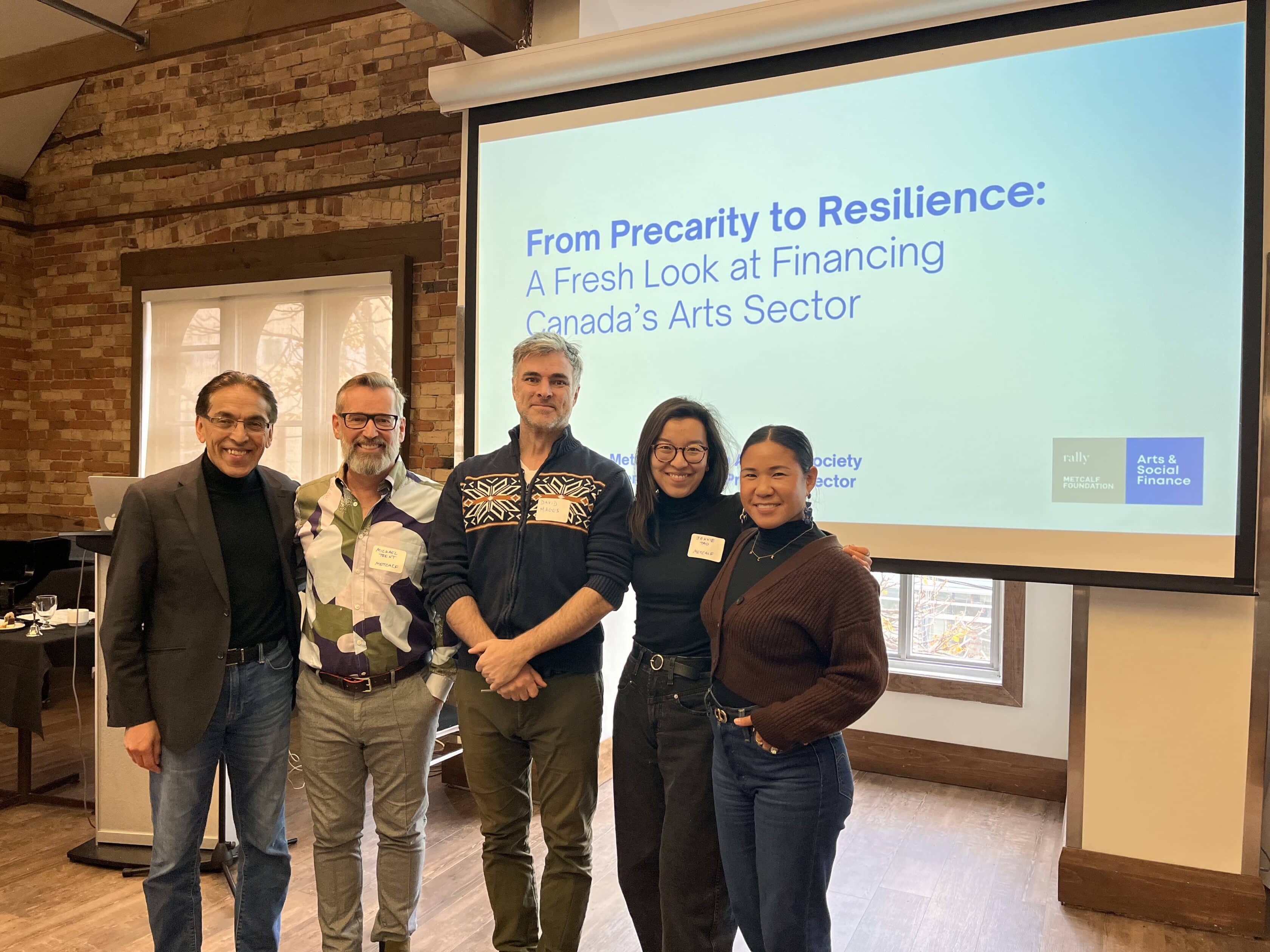
For decades, the Metcalf Foundation has supported artists, cultural organizations, and sector development initiatives while helping advance policy ideas and practical tools to improve long-term sustainability across the arts and culture sector. In recent years, this work has increasingly focused on how social finance might strengthen the resilience and adaptive capacity of Canada’s cultural nonprofit sector at a moment of growing structural pressure.
Arts & Social Finance emerged from that work. Developed through years of research, workshops, cross-country engagement, and dialogue with governments, investors, policymakers, and arts organizations, the initiative is designed as a practical response to deepening precarity across the cultural ecosystem. This work is being advanced in collaboration with Rally Assets, one of Canada’s leading impact investment firms with extensive experience building social finance infrastructure and mobilizing public and private capital through the Government of Canada’s Social Finance Fund. Together, Metcalf and Rally have examined how social finance operates across other public benefit sectors in Canada, as well as in cultural sectors internationally, asking whether similar tools could help strengthen Canada’s arts and cultural landscape.
At its core, Arts & Social Finance is a proposal to introduce affordable, repayable capital into Canada’s cultural nonprofit sector, supported by grant-based readiness and capacity-building programs. The initiative is designed to be additive — not a replacement for grants, but a resource designed to help organizations diversify revenue, strengthen fiscal capacity, build adaptive capability, and increase long-term resilience.
As the initiative continues to develop, we know it raises questions. We have tried to answer the most common ones in an FAQ.
The Problem
Canada’s cultural nonprofit sector is facing a structural problem. Despite historic increases in public funding over the past decade, precarity continues to deepen. Costs are rising, corporate sponsorship is declining, and organizations are becoming more dependent on grants — not less.
Over time, organizational behaviour becomes increasingly funder-centric, constraining experimentation and learning, while capacity-building initiatives struggle to generate lasting impact. The result is a system that converts ongoing public investment into renewable fragility — requiring continuous intervention without improving long-term resilience.
The Potential
Evidence from Canada and the UK suggests that introducing appropriate forms of repayable capital into the balance sheets of cultural nonprofits can strengthen organizational resilience. A 10-year, $60 million pilot fund in the UK demonstrated a lasting net increase in organizational resilience among participating organizations. These findings support the idea that combining grants with repayable capital can improve long-term outcomes — and that Canada’s cultural sector could benefit from a similar approach.
The Proposal
Arts & Social Finance is a proposed $100 million national investment fund designed to introduce two complementary resources into Canada’s cultural nonprofit sector: affordable, repayable capital, and non-repayable readiness grants that help organizations prepare to use it.
The capital would come from public, philanthropic, and private sources, with first-loss capital used to attract new investment into the sector. The fund would operate as a national, evergreen pool — recycling capital over time as loans are repaid, making public dollars go further. Loans would be structured below market rates to support a range of uses tied to revenue diversification and organizational strengthening. Alongside the loan capital, readiness grants would support organizations in building capacity, testing market opportunities, and developing the financial foundations needed to take on and service repayable capital.
This is not a replacement for grants. Grants remain essential, and Arts & Social Finance is designed to work alongside them. Its role is to help organizations diversify revenue, strengthen fiscal capacity, build adaptive capability, and increase long-term resilience — giving the sector an additional layer of support that the current system does not provide.
Readiness Is Central
One of the clearest lessons from international experience is that financing alone is not enough. Many cultural organizations need support to test new revenue models, build business plans, and understand how repayable capital can work within a cultural context. Without that foundation, repayable capital risks flowing mainly to organizations already equipped to access it — leaving much of the sector behind.
That is why a central component of Arts & Social Finance is ASF Build — a national investment readiness program that offers an orientation to social finance, cohort-based learning to develop revenue diversification strategies, and one-on-one support to test and model those strategies before any capital changes hands. ASF Build is designed to strengthen financial literacy, governance, and operational planning. Not every organization that goes through the program will proceed to a loan, and that is by design: the readiness work has value on its own, and loans will only be provided to organizations ready for investment.
What’s Next
Metcalf and Rally remain in active dialogue with provinces, territories, arts organizations, and sector leaders across the country, steadily building a roster of early adopters and refining the proposal in collaboration with the sector it is intended to serve. In May, we submitted a pre-budget recommendation to the federal government calling for a $50 million investment in Budget 2026 — a first-loss contribution that would help attract an additional $50 million from philanthropic and private-sector partners to fully capitalize the fund. Recent conversations with the federal government suggest the proposal is gaining traction as a policy priority.
We believe that Canada’s cultural organizations deserve a financing system built for their long-term success — and that philanthropy has a pivotal role to play not just in funding the sector, but in catalyzing and enabling the broader conditions it needs to thrive.